Astro vs Next.js vs Remix (React Router): Static Site Generators Comparison in 2026

If your enterprise site is running on Gatsby or another aging static site generator, you've likely felt the friction: build times stretching beyond acceptable limits, content updates requiring developer intervention, and a growing list of dynamic requirements your current setup was never designed to handle.
The question now isn't whether to evolve your architecture. The question is which framework deserves your team's investment for the next several years.
At Octahedroid, we've helped enterprise teams navigate this exact decision, evaluating Next.js, React Router (formerly Remix), and Astro against real organizational constraints rather than marketing materials.
The answer varies significantly depending on your content architecture, team expertise, and how you balance build-time efficiency against runtime flexibility.
Here's what our experience has taught us about each option.
Why Framework Selection Demands Serious Evaluation
Framework migrations consume significant organizational resources. Development time, training investment, potential productivity dips during transition, and the opportunity cost of features you won't build during migration all factor into the total cost.
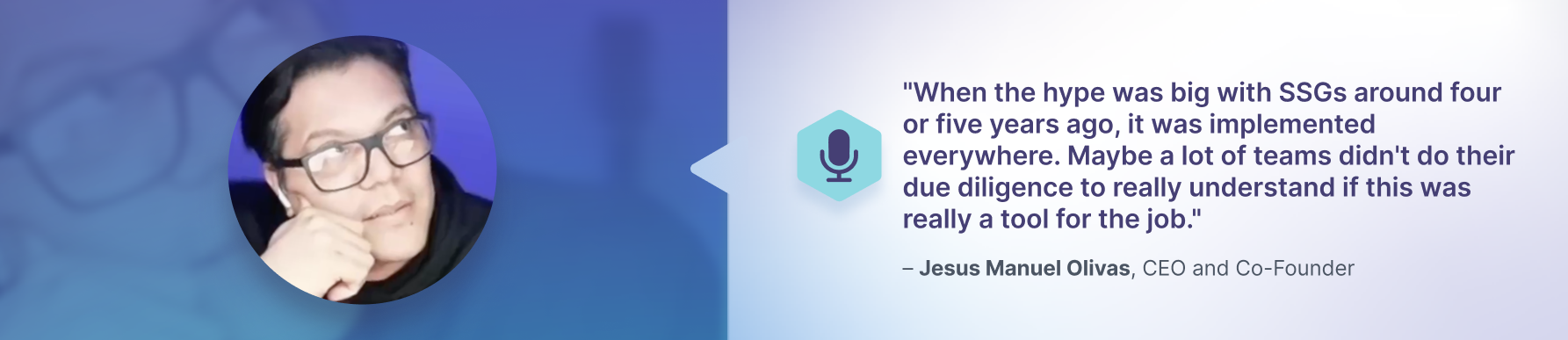
"When the hype was big with SSGs around four or five years ago, they were implemented everywhere. Maybe a lot of teams didn't do their due diligence to really understand if this was really a tool for the job they were trying to implement," explains Jesus Manuel Olivas, CEO and Co-Founder of Octahedroid.
The organizations that navigate this transition successfully share a common trait: they evaluate frameworks against their specific context rather than chasing the latest recommendations from hype.
For a deeper dive into assessing whether migration is right for your organization, see our article Enterprise Decision Framework: When to Migrate from Static Site Generators.
Framework Selection for Development Teams
Your framework choice should be based on your specific organizational context: your team's expertise, your content architecture, your scale challenges, and your long-term maintenance capabilities.
This understanding becomes the foundation for evaluating which framework makes sense for your migration.
Once you've mapped your content architecture and identified your edge cases, the next step is understanding what each framework actually offers. The three leading options for React-based teams migrating from Gatsby each take a different approach to solving the same core problems.
The table below breaks down how these differences translate into practical advantages and considerations for your team.
At a Glance: Framework Positioning
| Framework | Core Strength | Ideal Project Type | Notable Users |
|---|---|---|---|
| Next.js | Flexible rendering, mature ecosystem. | E-commerce, media, dynamic apps. | Nike, Spotify, TikTok. |
| React Router | Data handling, web standards. | Dashboards, booking systems, forms-heavy apps. | ChatGPT, Shopify, NASA. |
| Astro | Performance, minimal JavaScript. | Documentation, marketing, and content sites. | IKEA, Porsche, Cloudflare. |
Next.js: Comprehensive but Opinionated
Next.js remains the most widely adopted React framework for enterprise applications. That adoption creates tangible advantages: a mature ecosystem, extensive documentation, and a large talent pool familiar with its patterns.
The framework supports static generation, server-side rendering, and incremental static regeneration within the same project. React Server Components enable server-side data fetching directly within components, reducing client-side JavaScript. Turbopack has reached stability and delivers significantly faster build times for large projects.
The trade-offs center on flexibility and deployment.
Next.js is developed by Vercel and works most seamlessly on their infrastructure. While deployment elsewhere is possible, some features reach Vercel first, and the serverless experience differs across providers.
The framework's comprehensive nature also means there's typically a "Next.js way" to solve problems, which can feel constraining for teams preferring architectural freedom.
For e-commerce sites with frequent content updates, applications requiring real-time editorial previews, or organizations prioritizing long-term scalability with strong community support, Next.js delivers a well-documented path forward.
React Router: Control Over Convention
React Router (evolved from Remix) takes a fundamentally different stance. Rather than building abstractions over web platform APIs, it embraces them directly. Forms work without JavaScript. Data loading patterns feel closer to how the web was originally designed.
The loader and action patterns provide clear separation between data fetching and rendering. Nested routing with independent error boundaries means a failure in one section doesn't crash the entire page. Shopify's backing signals long-term investment and continuous evolution toward e-commerce demands.
The framework is intentionally less opinionated, which means more architectural decisions fall to your team. The ecosystem is smaller than Next.js, and the Remix-to-React-Router naming transition has created documentation gaps. Static site generation is now supported, but with more complexity than other frameworks offer.
For data-intensive applications, platforms with complex form workflows, or teams that value explicit control over data flow and prefer web standards over framework abstractions, React Router provides a leaner foundation.
Astro: Static by Default, Dynamic When Needed
Astro approaches the problem from a different angle entirely. Rather than assuming JavaScript is necessary everywhere, it treats static HTML as the default and JavaScript as an exception requiring justification.
The islands architecture loads JavaScript only for components that genuinely need interactivity. A product page might ship zero JavaScript for the description, images, and specifications, hydrating only the "Add to Cart" button and quantity selector. This structural advantage delivers exceptional Core Web Vitals without aggressive optimization effort.
Astro is also framework-agnostic. React components work alongside Vue, Svelte, or plain HTML in the same project. The Content Layer API integrates seamlessly with external APIs and headless CMS platforms. Astro DB adds database management for applications that outgrow typical static site needs.
For documentation sites, marketing pages, blogs, and content-heavy experiences where performance and SEO are paramount, Astro's architecture provides advantages that other frameworks require significant effort to match.
For understanding how these frameworks interact with your content management strategy, see our article on Headless CMS vs Static Site Generators: Choosing the Right Content Architecture.
Technical Comparison
| Feature | Next.js | React Router | Astro |
|---|---|---|---|
| Rendering | SSG + SSR + ISR | SSR (SSG improving). | SSG default. |
| JavaScript | Full, with RSC optimization. | Full, progressive enhancement. | Minimal, loads only as needed. |
| UI Frameworks | React only. | React only. | React, Vue, Svelte, Solid. |
| Back-End | API routes, serverless functions. | Strong server-side logic. | Limited, content-focused. |
| Deployment | Vercel-optimized. | Cloud-agnostic. | Multiple adapters. |
Build Time and Performance
| Aspect | Next.js | React Router | Astro |
|---|---|---|---|
| Build Scaling | Improves with Turbopack + ISR. | Minimal (generates on request). | Scales with page count. |
| First Visit | Fast (pre-rendered or cached). | Slower (server renders first visit). | Fastest (pure static). |
| JS Bundle Size | Larger baseline. | Full React app. | Smallest by default. |
| Content Updates | ISR rebuilds specific pages. | Cache invalidation at edge. | Rebuild or CMS-direct. |
When Migration Isn't the Answer
Before committing to a framework migration, honestly assess whether optimization of your current setup might suffice.
"Staying with the static site might be the best option at this very moment," notes Jesus Manuel Olivas. "Do the right planning. Maybe taking this slowly and making sure you take the right decision is way better. Maybe migrating is not an option."
Optimization strategies that extend your current framework's viability include splitting independent content sections into separate builds, offloading image processing to your headless CMS or services like Cloudinary, and implementing more aggressive dependency caching.
Making an Informed Decision About SSGs in 2026
Throughout this comparison, you've seen a recurring theme: your framework choice depends on your specific context. This reflects the reality of enterprise technology decisions.
Next.js offers the most comprehensive ecosystem and enterprise adoption, with extensive tooling and community support.
React Router 7 provides a lighter alternative that may require more manual work while offering greater flexibility.
Astro delivers exceptional performance for content-heavy sites with its islands architecture approach.
As Olivas puts it: "There's no silver bullet. There will be frameworks that are better at doing something than others, but in the end, the decision will be based on your own experience with frameworks and platforms."
With the right assessment process, hands-on evaluation, and gradual migration approach, you can make a decision you'll be confident about for years to come.
How Octahedroid Can Help You With Your SSG
At Octahedroid, we've guided dozens of enterprise teams through framework evaluation and migration. We help you understand your unique context and make the right choice for your organization.
Our approach includes strategic assessment of your edge cases and team capabilities, hands-on proof-of-concept projects with your actual content, realistic phased migration roadmaps, team training rather than dependency creation, and ongoing guidance throughout execution.
We specialize in practical, sustainable solutions. No hype, no vendor lock-in, no unnecessary rebuilds. Just frameworks that serve your needs and teams that can maintain them.
Ready to move beyond Gatsby and evaluate which framework is right for your organization? Schedule a free consultation with our team.
We'll assess your specific situation and provide honest guidance on your best path forward, whether that's Next.js, React Router 7, Astro, or strategic optimization of your current setup.

About the author
Related posts
AI vs. Automation: What’s the Difference and How to Choose the Right Layer
By David Cespedes, July 10, 2026What is the difference between AI and automation, and how do you decide which layer belongs where? Here’s our practitioner’s decision framework from enterprise pipeline implementations.
What Is Business Process Automation and How to Define What to Automate First
By David Cespedes, June 16, 2026Business process automation works when you define the right processes first. We discuss how to identify automation candidates and avoid the most common failure modes from our enterprise experience.
Take your project to the next level!
Let us bring innovation and success to your project with the latest technologies.