Productize Your Open Source Project: A Framework for Developer Tools That Get Adopted
The gap between releasing code and building adopted tools is product management. This also includes open-source tools, of course.
But while commercial products receive intentional user research, design consideration, and marketing investment, most open-source projects launch with the assumption that good code speaks for itself, but it doesn't.
In a recent webinar, my co-founder Omar Aguirre and I discussed what made Drupal Console one of the most widely adopted developer tools in the Drupal ecosystem.
The solution wasn’t more features or cleaner code. It was applying the same intentional development approach that successful product companies use.
Here's the framework that transformed Drupal Console from a personal learning tool into an essential part of thousands of developers' workflows, which can be applied to scale your open-source project.
Understanding Your Users: The Foundation of Open Source Product Success
The most common mistake in open-source development is building for an imaginary user who thinks exactly like you do.
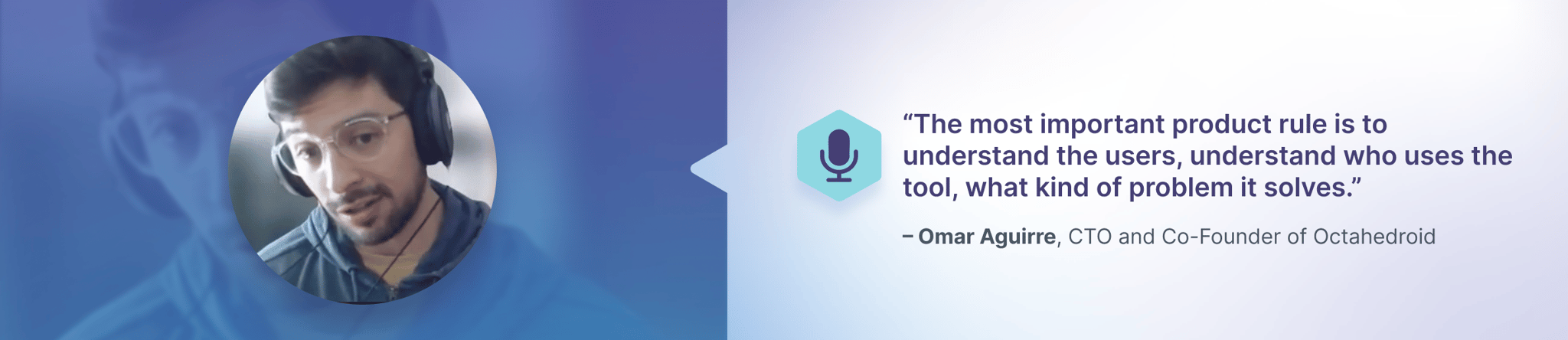
When Omar describes our approach to productizing open source projects, he always starts with the same point: the most important element is understanding the users. You need to understand who uses the tool and what kind of problem it solves. That awareness is probably the most critical factor in whether a project succeeds or fails.
This user understanding goes beyond demographics. In open-source contexts, you need to identify distinct personas with different relationships to your project:
- Primary users are the developers who use your tool daily and whose productivity depends on it working reliably. These users care about stability, clear documentation, and predictable behavior.
- Occasional users encounter your tool sporadically, often during specific project phases. They need excellent onboarding experiences and can't remember complex command syntax between uses.
- Then there are evaluators, senior developers, or technical leads who assess tools for team adoption. They care about maintenance status, community health, and long-term viability signals.
- Finally, contributors are developers interested in improving the tool. They need contribution guides, development environment setup, and clear project direction.
The user-persona exercise reveals conflicts that pure engineering approaches miss.
Primary users want stability; contributors want rapid iteration. Occasional users need simplified interfaces; power users want comprehensive options. Product thinking helps you make these trade-offs intentionally rather than accidentally.
When you start building something without structure, it can be really useful for you, but probably not for everyone.
That's when we started bringing in the concept of productizing: trying to understand who the users are, what personas are using the tool, and what problems they're actually trying to solve.
For Drupal Console specifically, our user research and feedback revealed that developers weren't just seeking automation. They needed confidence that the generated code followed current best practices during a period when Drupal 8 was still evolving rapidly.
Understanding that distinction shaped our entire development approach.
Documentation as Your Competitive Open-Source Advantage
Documentation is the primary factor determining whether users succeed with it or abandon it for alternatives.
Omar is honest about this: documentation is one of the most difficult parts of open source development because not a lot of us like to document. We just want to write code.
I really don't enjoy documenting either, but that's the thing that most of the time makes the difference between projects that get adopted and projects that don't.
The documentation challenge in open source differs from commercial products because you can't rely on customer success teams, onboarding calls, or paid support to fill gaps.
Your documentation must serve as the complete user experience for people across different skill levels, use cases, and languages.
Effective open source documentation follows a user journey approach:
- Discovery Documentation: Helps potential users understand whether your tool solves their problem. This includes clear problem statements, comparison matrices, and realistic examples of what the tool enables.
- Onboarding Documentation: Gets users from zero to their first successful outcome as quickly as possible. Time-to-value in open source often determines adoption more than feature completeness.
- Reference Documentation: Provides comprehensive coverage for experienced users who need specific information quickly. This documentation optimizes for searchability and completeness.
- Contribution Documentation: Enables other developers to extend and improve the project. Clear contribution guides directly impact project sustainability.
One of the biggest challenges we had with Drupal Console was making more people both contribute to the project and use it effectively.
We pushed to make it multilingual, to make it easier for users across different regions to use the platform and contribute back. We ended up with documentation in multiple languages covering both how to use the tool and how to contribute improvements.
This meant understanding how developers in different regions approach similar problems, what examples resonate across cultures, and how language affects technical concept explanation.
When your user base is distributed across multiple countries speaking multiple languages, that investment in accessibility pays significant dividends.
Documentation also serves as a forcing function for product clarity. If you can't explain how to use a feature clearly, the feature itself might be poorly designed.
The discipline of writing user-focused documentation often reveals interface improvements and workflow optimizations that pure code review misses.
Developer Experience: Making Users' Lives Easier
Developer Experience (DX) is product design applied to tools that developers use. While user experience focuses on end-user interactions, DX optimizes for developer productivity, confidence, and satisfaction.
Developer experience is something I really care about in our projects.
My focus is always on making people's lives easier, saving them time, and making users happy. That's what matters when you're building tools for developers.
Excellent DX starts with understanding developer workflows in context. Developers don't use tools in isolation. They integrate them into existing processes, combine them with other tools, and adapt them to team conventions.
Your tool's success depends on how well it fits these existing patterns.
Here are some DX principles I consider crucial for open-source developer tools:
- Sensible Defaults: Users should achieve useful results with minimal configuration. The default behavior should solve the most common use case effectively. Advanced customization can require more setup, but basic functionality should "just work."
- Progressive Disclosure: Present simple interfaces initially while making advanced features discoverable when needed. For example, command-line tools can offer both basic and verbose modes. Clear Error Messages: When something goes wrong, help users understand both what happened and how to fix it. Generic error messages force users to guess; specific error messages with suggested solutions build confidence.
- Predictable Behavior: Similar inputs should produce similar outputs. Consistent naming conventions, parameter ordering, and response formats reduce cognitive load for users working with multiple related commands or functions.
- Integration Friendly: Design for composition with other tools. Support standard input/output formats. Respect common environment variables and configuration patterns. Enable scripting and automation scenarios.
The Drupal Console team applied these principles by focusing on time-saving as the ultimate value proposition. Rather than requiring developers to remember complex Drupal 8 APIs, the tool provided interactive prompts that guided users through code generation while teaching proper patterns.
This approach revealed an important DX insight: tools that educate while automating create more value than pure automation.
Users develop confidence in the generated code because they understand the decisions being made on their behalf.
For frontend frameworks, excellent DX might mean hot reload that preserves application state. For CLI tools, it could be intelligent autocomplete that adapts to project context. The specific implementation varies, but the principle remains: optimize for developer productivity and confidence in realistic usage scenarios.
Learn more about how framework selection affects developer experience in our comparison of modern static site generators and their DX implications in our Static Site Generators Comparison in 2026.
Marketing Your Open-Source Product
Marketing open-source projects requires different strategies than marketing commercial products, but it's equally essential for adoption. The best tool that nobody knows about provides zero value.
"Marketing and promotion is so important," Jesus emphasizes when discussing what made Drupal Console successful. "Attending conferences, speaking at conferences, doing trainings that helps because you are building material, teaching people how to use a particular tool."
Open-source marketing differs from commercial marketing because you're not selling a product; you're building awareness and demonstrating value. The goal is to help potential users understand how your tool fits into their existing workflows and what problems it solves better than alternatives.
Effective marketing channels for developer tools:
- Conference Speaking: Technical conferences provide direct access to your target audience. Speaking slots position you as an expert while demonstrating tool capabilities in realistic scenarios. The key is showing workflows rather than features and help attendees envision using the tool in their own projects.
- Training Materials: Creating educational content serves dual purposes: it helps users succeed with your tool while establishing your expertise. Video tutorials, workshop materials, and hands-on examples make abstract capabilities concrete.
- Community Building: Engaging with existing communities where your users congregate builds relationships and credibility. Contributing to discussions, helping solve problems, and sharing relevant insights establishes you as a valuable community member rather than just a tool promoter.
- Content Marketing: Technical blog posts, case studies, and problem-solving guides attract users researching solutions. The content should focus on user outcomes rather than tool features. Show how the tool solves real problems.
- Social Proof: Testimonials, adoption stories, and usage metrics help potential users assess whether the tool is worth investigating. Highlighting diverse use cases demonstrates versatility and broad applicability.
When you put all these pieces together at a conference or event, talking about the tool and demonstrating how to use it properly, people understand.
They realize this tool could help them save time or be more productive. Time is money, and they realize this is something real, something they can actually use. They see there's documentation, and that it's not as hard to use as they thought.
That's when adoption happens: when people realize the tool could be useful for a particular task at their job. It could make them look good.
The Feedback Loop: From Community Input to Product Direction
One of the unique advantages of open source development is direct access to your user community. Converting that access into actionable product insights requires intentional feedback collection and analysis.
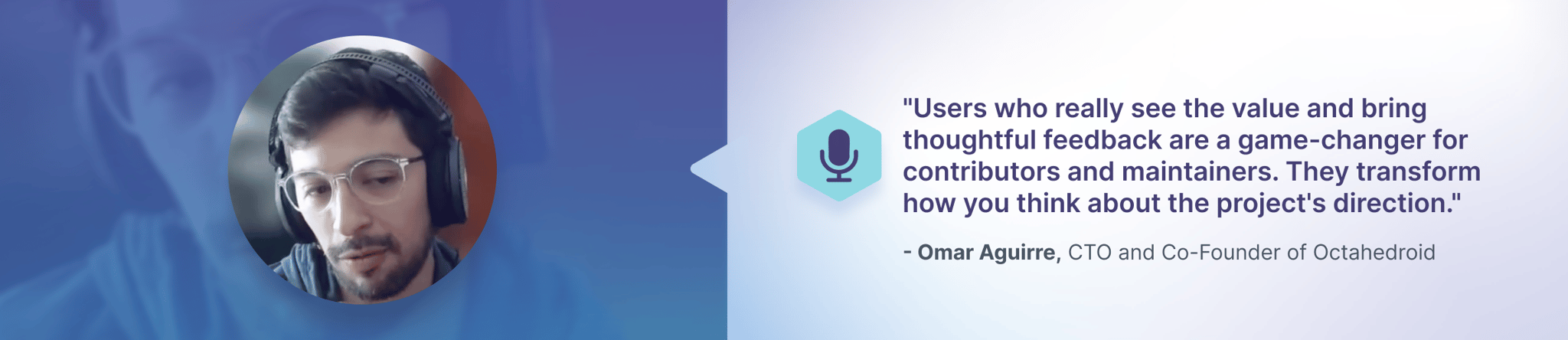
Omar describes this well: there are people outside your immediate circle who know a lot about what you're doing, who really see the value in your tool and bring genuinely good feedback. That kind of user input is a game changer for contributors and maintainers. It transforms how you think about the project's direction.
Effective feedback collection in open source contexts goes beyond GitHub issues. While bug reports and feature requests provide valuable input, they represent only a subset of user experiences. Many users struggle silently, work around limitations without reporting them, or abandon the tool when they encounter friction.
Strategies for comprehensive feedback collection:
- Usage Analytics: Understanding how people actually use your tool reveals gaps between intended workflows and real-world usage patterns. Command-line tools can collect anonymized usage statistics. Libraries can track common error patterns or frequently accessed documentation sections.
- Direct User Interviews: Speaking with actual users uncovers context that bug reports miss. Why did they choose your tool over alternatives? What workflows do they use it for? What almost prevented them from adopting it? These conversations provide strategic insights for product direction.
- Community Engagement: Participating in forums, chat rooms, and social media where your users discuss problems provides unfiltered feedback. Users often discuss tool limitations and workarounds in these contexts more candidly than in formal feedback channels.
- Contribution Pattern Analysis: Examining what features contributors propose and what improvements they prioritize reveals user needs. Contributors typically invest time in changes that solve their own problems, making their priorities a proxy for user pain points.
- Documentation Analytics: Tracking which documentation sections receive the most attention and where users drop off indicates areas of confusion or missing information. High-traffic documentation topics suggest common use cases worth optimizing.
The feedback analysis process requires balancing multiple perspectives. Individual user requests might not represent broader community needs. Vocal users might have different priorities than the silent majority. Contributors might have different needs than pure consumers.
The users who really see the value and provide thoughtful, strategic feedback become transformative for project development. Their input tends to focus on workflow improvements rather than individual bug fixes. Instead of implementing random feature requests, you can prioritize changes that improve user success rates and expand the tool's utility for core workflows.
This type of feedback became a game-changer for Drupal Console's development because it provided direction for product evolution rather than just maintenance tasks.
Building Open-Source Adoption Through Product Principles
The shift from building for developers to building for user outcomes requires rethinking success metrics and development priorities.
Traditional open-source metrics such as stars, forks, and commits measure activity rather than user success. Product-focused metrics measure impact.
Meaningful success indicators for open source developer tools:
- Time-to-Value: How quickly can new users achieve their first successful outcome? Tools with shorter learning curves and clearer onboarding achieve higher adoption rates.
- User Retention: Do users continue using the tool after initial trial? Retention indicates that the tool provides ongoing value rather than one-time utility.
- Community Health: Are users helping each other? Healthy communities indicate that the tool has achieved sufficient adoption and user success to sustain peer support.
- Workflow Integration: Do users integrate the tool into automated processes, team workflows, or larger systems? Integration suggests that the tool has become essential rather than optional.
- Problem Resolution Rate: How effectively does the tool solve the problems users adopt it for? Success rate indicates product-market fit for the specific use cases the tool targets.
The product approach also influences development prioritization. Instead of implementing the most technically interesting features or the loudest feature requests, product-focused development prioritizes changes that improve user success rates.
This might mean improving error messages before adding new capabilities, optimizing common workflows before supporting edge cases, investing in documentation and examples before expanding feature sets, or building integration APIs before developing standalone functionality.
The long-term sustainability benefit of product thinking is that successful users become advocates. They recommend the tool to colleagues, contribute improvements that benefit their own workflows, and provide feedback that guides strategic development.
For more on how sustainable motivations and community building contribute to success, see our article on why open-source projects fail here.
Tools that solve real problems for satisfied users generate network effects that pure technical excellence cannot achieve. Users share solutions that work. They contribute improvements that benefit their own workflows. They provide feedback that guides strategic development.
This cycle creates sustainable growth that doesn't depend solely on the original maintainer's continued involvement.
Ready To Apply Product Thinking to Your Open-Source Project?
At Octahedroid, we help development teams implement these frameworks strategically, whether you're launching new projects or optimizing existing ones.
Contact us for a consultation to discuss how product management principles can accelerate your open source project's adoption and impact.

About the author
Related posts
AI vs. Automation: What’s the Difference and How to Choose the Right Layer
By David Cespedes, July 10, 2026What is the difference between AI and automation, and how do you decide which layer belongs where? Here’s our practitioner’s decision framework from enterprise pipeline implementations.
What Is Business Process Automation and How to Define What to Automate First
By David Cespedes, June 16, 2026Business process automation works when you define the right processes first. We discuss how to identify automation candidates and avoid the most common failure modes from our enterprise experience.