Pattern Machines vs Reasoning Systems: A Perspective on AI Development

Using AI to write code can feel unpredictable. Sometimes the output is exactly what you need. Other times, it's completely off target.
This variability isn't a bug in the system. It's a fundamental characteristic of how large language models work.
At Octahedroid, our engineering team has discovered a clear pattern that determines success or failure with AI tools: the difference between pattern matching and actual reasoning.
This has become essential for how we approach AI adoption, and it's something every development team should consider before integrating these tools into their workflows, as we talked about in our last webinar on the topic.
How We Think About AI: Pattern Machines vs. Reasoning Systems
Many of today's AI tools behave like pattern machines. Based on features and characteristics, they learn to identify and classify patterns in data.
Given enough examples, the system learns correlations and regularities in text, images, code, or signals and reproduces them when prompted.
Large language models don't reason about code the way developers do. They predict the most statistically probable next sequence based on patterns learned from billions of lines of training data.
When you ask an AI to create a React component, it's not analyzing your application architecture or understanding your business requirements. It's assembling code patterns that it has seen work in similar contexts before.
Ezequiel Olivas, Front-End Engineer at Octahedroid, puts it simply: "AI’s not ready to be in the whole development workflow, but it's good enough to help me find better solutions."
Real reasoning in AI, by contrast, aims to simulate human-like cognitive processes such as deduction, induction, analogical reasoning, multi-step problem solving, and contextual decision-making.
Reasoning systems are typically built around a structured knowledge base and an inference engine that applies logic to reach justified conclusions, not just plausible ones.
Eduardo Noyer, Back-End Engineer on our team, puts it plainly: "Everyone is experimenting with AI, but it's still about finding the proper context for it to be instrumental."
This distinction between pattern matching and reasoning determines which development tasks benefit from AI assistance and which still require human expertise.

Where We've Found AI Actually Works: Front-End Development
Front-end development has emerged as the area where AI tools provide the most consistent value for our teams.
The reason is straightforward: front-end work often decomposes into small, pattern-rich units that align with how language models operate.
Consider a typical frontend task like building a button component with variants, states, accessibility attributes, and Storybook documentation.
These components follow established patterns, reference design systems with clear conventions, and can be validated quickly through visual inspection.
Front-end development aligns particularly well with AI capabilities for several interconnected reasons:
- Clear patterns exist throughout the discipline. Design systems provide explicit rules for components, spacing, colors, and interactions that AI can follow consistently.
- Visual feedback is immediate, allowing you to see within seconds whether a generated component matches the design specification.
- The context is containable, meaning a single component along with its props, styles, and tests typically fits within the AI's context window.
- Validation is straightforward, with clear answers to questions like whether a button looks right or has the correct accessibility attributes.
- The visual nature of frontend work creates a rapid feedback loop. You generate a component, render it in the browser, and validate it immediately. There's no complex hidden state to debug or service boundaries to trace through.
Our development teams are finding AI particularly effective for converting CSS to design tokens quickly and consistently, generating Storybook stories that match house style conventions, writing Playwright tests from component specifications, and refactoring individual components with clear before/after states.
The key is that these tasks have well-defined inputs, established patterns to follow, and straightforward validation methods. AI handles the repetitive work consistently, but the output still requires human review.
Where AI Falls Short: Back-End Complexity and System Reasoning
Back-end development presents a fundamentally different challenge.
The work involves reasoning about system behavior, understanding cross-service dependencies, and making architectural decisions that require deep context about your specific environment.
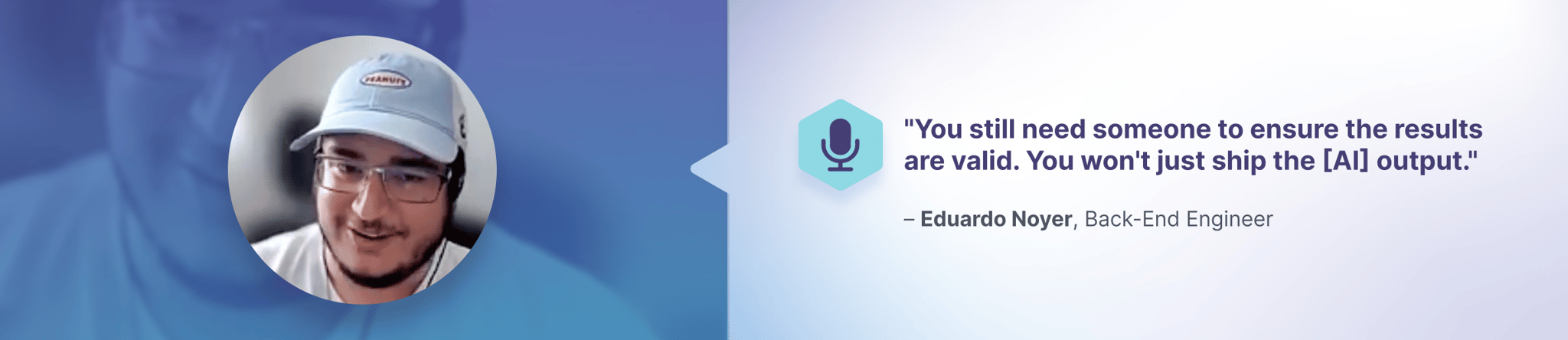
Eduardo emphasizes this point: "You still need someone to ensure the results are valid. You won't just ship the output."
Consider decomposing a monolithic service into microservices.
An AI might generate clean architectural diagrams or well-structured OpenAPI specifications, but it cannot reliably reason about which data must move together to maintain consistency, how retry logic should cascade across service boundaries, what happens when Service A is down but Service B receives a request, whether you'll hit rate limits under peak load, or how to handle partial failures while meeting service level agreements.
These aren't pattern-matching problems. They require understanding your specific system constraints, your organization's data residency rules, and your team's operational capacity.
Back-end work often involves coordinating across multiple systems:
- Database transactions require understanding ACID properties, isolation levels, and when eventual consistency is acceptable based on your specific use case.
- Message queues demand designing idempotent consumers and handling poison messages depending on your system's reliability requirements.
- External APIs need managing rate limits, retry strategies, and circuit breakers based on understanding the behavior of systems you don't control.
AI tools can suggest patterns they've seen work elsewhere, but they lack the context to know which patterns fit your constraints.
The fundamental limitation for complex development work is context. You cannot provide an AI with your entire repository, five years of architectural decisions, and all the implicit knowledge your team has accumulated.
The AI operates within a limited context window, making decisions based on incomplete information. It doesn't know about your compliance requirements, budget limitations, or operational constraints that eliminate certain architectural choices. It can't trace how a change in one service will cascade through your entire system because it doesn't have access to all the interconnected components.
While AI models are trained on public code, they don't automatically understand your team's conventions, your legacy system quirks, or your domain-specific patterns.
The AI doesn't know your on-call rotation capacity, your monitoring capabilities, or your team's ability to maintain complex solutions.
These limitations mean that for system-level decisions, human developers who understand the full context remain irreplaceable.
How We Decide When to Use AI
Based on our experience, we've developed a framework for evaluating AI suitability for specific tasks.
We ask ourselves these questions:
- Is the context small and fully providable? Can you give the AI everything it needs to know in a single prompt or conversation?
- Are there strong patterns the AI can follow? Has the AI likely seen similar problems solved in its training data?
- Can you quickly validate the output? Can you tell if the AI's suggestion is correct without extensive testing or deployment?
If the answer is yes to all three questions, we take an AI-first approach with human review.
If the answer is no to any of them, we take a human-first approach with AI as a support tool.
We also consider what happens if the AI is confidently wrong, whether we can detect that error quickly, and what the blast radius of a mistake would be. High blast radius requires more human oversight, regardless of how well the task fits AI capabilities.
We've found that different development tasks align differently with AI capabilities.
For front-end development, we see high AI suitability in UI component scaffolding with clear patterns and visual validation, component documentation using standardized formats with style guides, unit tests for pure functions with deterministic inputs and outputs, and CSS to design tokens with strong templating and careful review.
For back-end development, the suitability is variable.
REST client wrappers work well for boilerplate, but require verifying error handling.
Simple CRUD operations have existing patterns, but we verify business logic carefully. Data migration scripts present hidden constraints that make them high risk.
Service decomposition requires architectural reasoning and shows low AI fit. Cross-service reliability involving state management and failure budgets needs human expertise.
The pattern is consistent: as context requirements grow and reasoning complexity increases, human developers become essential.
From Understanding AI to Implementing AI
Recognizing where AI helps versus where it falls short is the foundation. The next step is building processes that make AI assistance consistent and measurable.
We've written extensively about this in two companion pieces.
Our AI Principles for Web Development Teams covers the guidelines we use for evaluating AI integration, including why processes must come before automation, and how to calculate the true cost of AI beyond token usage.
Our Human-Assisted AI Development Framework article details the four-phase methodology we use for production systems: specification before generation, context-rich implementation, reverse prompting to extract patterns, and architecture enforcement.
One insight worth highlighting here: "AI made us faster" is a feeling, not a metric. Real measurement requires looking at the complete development lifecycle, not just initial code generation.
We've seen AI-assisted features ship faster initially but require more debugging time post-deployment. The net is often still positive, but rarely as dramatic as the headlines suggest.
What We've Learned About AI Development
The difference between teams that succeed with AI and those that don't comes down to clarity about what these tools can and cannot do.
Pattern matching excels in narrow, pattern-rich contexts. It accelerates routine work, generates boilerplate efficiently, and helps developers explore unfamiliar code.
Human developers remain essential for judgment calls, novel problems, and reasoning about system-specific constraints.
At Octahedroid, we've found that the teams seeing real value aren't the ones using AI the most. They're the ones who have identified exactly where it works, built proper governance to prevent issues, and measured results honestly.
Contact us for a consultation to discuss how AI tools might fit into your development workflows, with realistic expectations about where they help and where human expertise remains essential.

About the author
Related posts
AI vs. Automation: What’s the Difference and How to Choose the Right Layer
By David Cespedes, July 10, 2026What is the difference between AI and automation, and how do you decide which layer belongs where? Here’s our practitioner’s decision framework from enterprise pipeline implementations.
What Is Business Process Automation and How to Define What to Automate First
By David Cespedes, June 16, 2026Business process automation works when you define the right processes first. We discuss how to identify automation candidates and avoid the most common failure modes from our enterprise experience.
Take your project to the next level!
Let us bring innovation and success to your project with the latest technologies.